Showing posts with label Italy. Show all posts

Thursday, December 4, 2025

Muratura Viva: the quiet suffocation and pious prison of Sister Virginia Maria, the ‘Nun of Monza’

A stark, theatrical poster for The Lady of Monza (1969) presents Anne Heywood in the habit of a cloistered nun, shown seated on the ground in a posture that fuses vulnerability with anguished defiance. Her body is half-turned from the viewer, arms drawn protectively around herself, her veil displaced as though by some unseen turmoil. Looming beside her stands a faceless male figure in dark, gleaming boots and ecclesiastical robes, his presence rendered as an oppressive vertical column against which she is visually and symbolically trapped.  The typography declares, ‘Her other love is God’, while a block of text alludes—elliptically rather than graphically—to the moral and emotional catastrophe at the film’s core: a nun violated within the convent walls and thereafter torn between faith, desire, and transgression. The image as a whole operates in the idiom of late-1960s exploitation cinema: austere, melodramatic, and deliberately provocative, hinging on the collision of piety, coercion, and forbidden longing.
Anne Heywood in The Lady of Monza, 1969.

4 December 1575 — Milan gave birth to one of the most haunting figures of its age: Marianna de Leyva y Marino, whom the chronicles shall later name the Nun of Monza. Her life reads less as a tale of mortal days than as gothic tragedy. Her mother gone before memory could form, her father—aloof, imperious, and full of worldly designs—consigned her at thirteen unto the convent: that most devout of prisons. In sixteenth-century Christendom it was a fate laid upon daughters with grievous frequency, though veiled in sanctimony; the Church styled it devotion, the fathers called it prudence, and the maidens themselves suffered no voice at all. It is a grim practice that remains, alas, persistently alive in certain corners of the globe and within that institution to this very day.

As Sister Virginia Maria, she endured the quiet suffocation of cloistered life until, around twenty-one, desire—or coercion—broke through the walls. Her seducer, the nobleman Giovanni Paolo Osio, already tainted by blood and infamy, drew her into a commerce of the flesh that shocked even the jaded chambers of Lombardy. From their furtive union sprang a child, living witness of the transgression. When discovery loomed, Osio’s response was murder; a fellow sister who dared speak was silenced forever. The crimson deed did eventually seal their destinies: Osio fled justice, but Sister Virginia had no such escape.

The Church tried her, condemned her, and sentenced her to muratura viva—to be literally walled alive. No mere imprisonment, it was a ritualised living death: a stone cell scarcely larger than a coffin, air eked through a narrow grate, and silence unbroken save for the scrape of victuals slid through a hatch. Rations were meagre: sufficient to sustain the body, but never to comfort it. Days, seasons, and years bled into one another in the half-dark, until even the sense of self began to fray. There Sister Virginia Maria remained for thirteen years, until the hierarchy, either moved by her ‘repentance’ or its own convenience, saw fit to loose from those walls a spectre in the shape of a woman.

She lived thereafter—if such ghostly continuance may be called life—within the Monastery of Saint Margaret, her frame doubtless sorely enfeebled, until she reached seventy-four. Her endurance, perchance, may be viewed as a quiet defiance, a sermon preached against the cruelty which clothed itself in piety’s robe.

Across the centuries her legend hath been stirred anew by the arts. In Eriprando Visconti’s film of 1969, The Lady of Monza (also known as The Awful Story of the Nun of Monza), the renowned British actress Anne Heywood lendeth once more a voice unto the tormented sister—a cry rising out of stone and sorrow. Through her portrayal we behold the eternal strife betwixt faith and flesh, puissance and conscience. History nameth it sin; posterity perceiveth therein the fierce and trembling labour of survival.

Copyright 2025, Arthur Newhook.

Tuesday, October 28, 2025

Actress Constance Dowling, 24 July 1920 – 28 October 1969

Actress Constance Dowling reclines on a velvet chaise longue trimmed with gold fringe, her pose poised between languor and contemplation. Clad in a cream skirt patterned with oversized bows and a fitted dark top that accentuates her classical silhouette, she radiates an air of weary elegance—beauty not as ornament, but as quiet endurance. One arm supports her head, her expression thoughtful, almost remote, while her long legs, gracefully extended, lend the composition a sculptural equilibrium. The subdued palette—muted ochres, soft crimsons, and pale ivory—infuses the image with a painterly intimacy, as though caught between glamour and introspection. Dowling appears as a figure suspended in time: a relic of mid-century melancholy, embodying both the poise of Hollywood’s golden age and the private ache that often shadowed it.
source unknown

Constance Dowling (née Smith), a native of New York City whose life was indelibly shaped by the opposing forces of beauty and sorrow, departed this ungrateful world on this day in 1969, her existence curtailed prematurely at the age of forty-nine by catastrophic cardiac failure. Statuesque, preternaturally luminous, and possessed of an almost Roman composure, she epitomised a rare archetype: a woman whose sensibilities were anachronistically modern—a paradoxical synthesis of bohemian intellect and cinematic glamour. She moved through the gravitational field of 1940s Hollywood with a singular blend of languid insouciance and restrained defiance.

Her ingress into the cinematic realm occurred beneath the aegis of Samuel Goldwyn, debuting in Up in Arms (1944) alongside Danny Kaye, Dinah Shore, and Dana Andrews. Yet it was the crucible of post-war Italy that would ultimately define her—a brief but incandescent dominion between 1947 and 1950, when the moral and material detritus of Fascism engendered a cinema of unvarnished realism and startling sensuality. Within this milieu she found not only artistic emancipation but also a deeply personal liberation, as though the ruins of Europe offered her a canvas vast enough to accommodate the contradictions of her nature.

Her biography, however, is interwoven with shadowed threads: a conspicuous liaison with the formidable director Elia Kazan, and a tempestuous, ultimately ruinous entanglement with the tormented poet Cesare Pavese. Apocryphal accounts maintain that Pavese’s suicide was, at least in part, precipitated by her rejection—a supposition both melodramatic and, perhaps, not wholly unfounded. (Truth, as ever, resists the neatness of gossip, and no aspersion is cast here).

In 1955 she withdrew from the screen following her marriage to the Hungarian-born producer and director Ivan Tors, a man of visionary temperament whose interests spanned science and metaphysics, and who had produced her final picture, Gog (1954). Their union was marked by an almost utopian idealism: they adopted children from Kenya and surrounded themselves with a circle of avant-garde scientists and mystics. Indeed, it has been posited that Constance herself facilitated the neuroscientist John C. Lilly’s first encounter with the psychotropic revelations of LSD in 1964. Verily, a curiously esoteric trajectory for a mid-century Hollywood starlet.

Hers was a transient constellation within the cultural firmament, yet one that blazed with perilous vitality—a tripartite existence poised between intellect, sensuality, and sorrow in equal measure. Constance Dowling remains an enigmatic presence who traversed the borders of Hollywood and Rome, glamour and grief, leaving behind the indelible impression of a spirit whose brilliance was, perhaps, too intense to be sustained. —Arthur Newhook, 28 October 2025.

Copyright 2025, Arthur Newhook.
Tuesday, September 30, 2025

Monica Bellucci: even the farmyard bends into reverence beneath her gaze


It is no exaggeration to suggest that Mother Nature shattered the mould in fashioning this one: the Italian divinity Monica Bellucci, born 30 September 1964. Photographed by Frederic Meylan, c. 1991.

Copyright 2025, Arthur Newhook. On X-TWITTER: @DollsFallen and @Sunking278. BLUESKY - @arthurnewhook.bsky.social. REDDIT - https://www.reddit.com/user/SiberianKhatru278/. FULL LIST OF LINKS - linktr.ee/arthurnewhook. DONATIONS GRATEFULLY ACCEPTED on Cash App ($ANewhook) and at https://tinyurl.com/ArthurNewhook.

Saturday, September 7, 2024

Born #OTD 1914: Lída Baarová, the Czech actress who became the mistress of Joseph Goebbels

Photo: Sueddeutsche Zeitung Photo/INTERFOTO/Alamy Stock Photo

Lída Baarová’s dalliance with the Nazi minister of propaganda, Joseph Goebbels, which endured from 1936 to 1938, caused such grievous torment to Goebbels’ wife, Magda, that she appealed directly to Adolf Hitler for intervention. As Hitler was preparing for the invasion of the Sudetenland, he decreed that Herr Goebbels and Fräulein Baarová cease their affair, and forbade Baarová from performing on stage or screen. Exiled to Prague, now under the heel of Nazi rule, Baarová was eventually allowed to appear in a few productions. She also resided and performed in Fascist Italy during the Second World War. Upon the Allied victory in Europe, Baarová returned to Germany, whereupon she was seized by American military officers and sent back to Prague to face trial. 

Released in 1947 due to a lack of evidence to convict her, she then took a brief sojourn in Argentina with her then-husband. Thenceforth, after living in poverty and apparently unhappy in her marriage, she returned to Europe and revived her career to a small degree, appearing in several Italian films during the 1950s. In 1958, she moved to Salzburg, Austria, where she wedded a wealthy physician, and there spent the rest of her days, until she departed this mortal coil on 27 October 2000.

Photo: Lída Baarová, circa 1937, doth strike a poised and elegant stance, adorned in a most glamorous, embellished two-piece array with intricate design. Her raiment consists of a sparkling, sequined bodice and a matching skirt, bedecked with ornate and ruffled adornments. With both hands, she holds the sides of her skirt, spreading it wide to display its elaborate craftsmanship. Her tresses flow in soft waves, and she doth gaze off to the side with a composed and confident countenance.

Copyright 2024, Arthur Newhook. @Sunking278 and @FloydEtcetera on X, and at the same handles on FACEBOOK. MASTODON - @ArthurNewhook@mastodon.world, BLUESKY - @arthurnewhook.bsky.social. DONATIONS GRATEFULLY ACCEPTED at https://tinyurl.com/ArthurNewhook.

Thursday, August 29, 2024

From adoration to ostracism: the American public's betrayal of the radiant and supremely talented actress Ingrid Bergman (born #OTD 1915, also died on this day in 1982)

Ingrid Bergman in 'Casablanca', 1942 Warner Bros. Photo: Everett Collection

In the 1940s, US audiences elevated Swedish actress Ingrid Bergman to a near-saintly status, with her most memorable roles arguably being Ilsa Lund in ‘Casablanca’ and her Academy Award-winning portrayal of Paula Alquist Anton in 1944’s ‘Gaslight’. During the early 1950s, however, the same American public that once adored her turned against her (as is so often their fickle nature). She was harshly criticised and unfairly condemned for having an affair and a child out of wedlock with director Roberto Rossellini, leading to her being ostracised from Hollywood for a few years and forced to remain in exile in Italy. 

Undeterred, Bergman made a triumphant return to Hollywood with her Academy Award-winning role in 1956’s ‘Anastasia’ and remained a revered figure in the industry for the rest of her life. She won the Best Supporting Actress Oscar again for 1974’s ‘Murder on the Orient Express’ and was nominated once more for 1978’s ‘Autumn Sonata’. Ingrid Bergman departed this mortal coil in London on her 67th birthday after a long and courageous battle with cancer. Despite the ingratitude and self-righteousness displayed by American audiences, Ingrid Bergman’s legacy remains as bright as ever globally, and her name will not be forgotten.

Copyright 2024, Arthur Newhook. @Sunking278 and @FloydEtcetera on X, and at the same handles on FACEBOOK. MASTODON - @ArthurNewhook@mastodon.world, BLUESKY - @arthurnewhook.bsky.social. DONATIONS GRATEFULLY ACCEPTED at https://tinyurl.com/ArthurNewhook.

Monday, August 5, 2024

Tullia, the daughter of a noble Roman sire, whose light, as ancient tales proclaim, burned for fifteen centuries beyond her mortal coil

AI generated image

The cherished daughter of prominent Roman Republic statesman and orator Marcus Tullius Cicero, Tullia (circa 79 BCE - 45 BCE), died in her mid-thirties whilst giving life to her second son. Her existence, painted with certainty in the hues of time, is illuminated through her father’s surviving letters, which reveal that she was a steadfast pillar of support and comfort for Cicero amidst his tempestuous political and personal trials. Thrice did Tullia wed, with each union ending in severance or widowhood. It is said that, in the fifteenth century AD, her sepulchre was unveiled in Rome, and there, her form lay untouched by decay, as if slumbering but a moment past. Beside her rested a lamp, its flame unwavering, a mystery to those who discovered it, a beacon perhaps eternally ignited since the day she was laid to rest.

Copyright 2024, Arthur Newhook. @Sunking278 and @FloydEtcetera on X, and at the same handles on FACEBOOK. MASTODON - @ArthurNewhook@mastodon.world, BLUESKY - @arthurnewhook.bsky.social. DONATIONS GRATEFULLY ACCEPTED at https://tinyurl.com/ArthurNewhook.

Monday, April 15, 2024

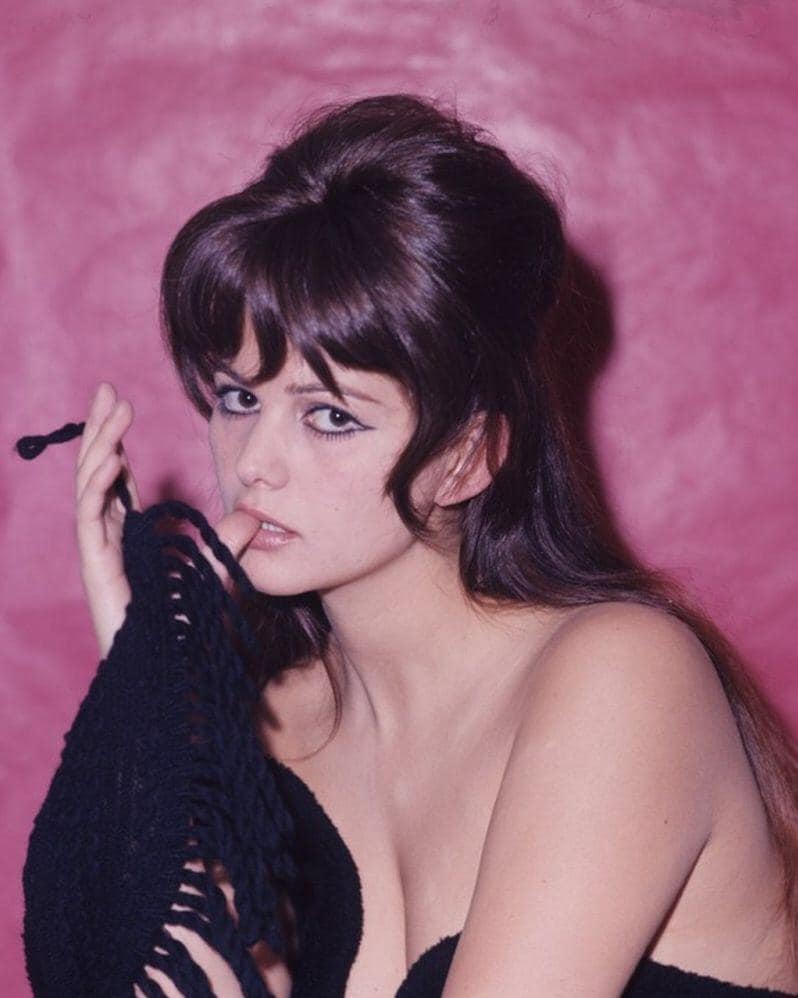
Born #OTD 1938: Claudia Cardinale

Claudia Cardinale by Angelo Frontoni

Italian actress Claudia Cardinale achieved considerable fame in Hollywood between 1963 and 1968 before dedicating herself to Italian and French cinema. Born unto Sicilian parents in French Tunisia, Signorina Cardinale possesses fluency in five languages: French, Italian, Spanish, Arabic, and English. During her time in the Hollywood realm, she starred alongside notable figures such as Rock Hudson, Anthony Quinn, Rod Steiger, John Wayne, and Rita Hayworth (the latter two in 1964’s 'Circus World'). Cardinale continued to grace the screen as late as appearing in a Swiss television mini-series in 2020. Let us raise our voices in hope the esteemed lady is having a wonderful 86th celebration of life.

Copyright 2024, Arthur Newhook. @Sunking278 and @FloydEtcetera on X, and at the same handles on FACEBOOK. MASTODON - @ArthurNewhook@mastodon.world, BLUESKY - @arthurnewhook.bsky.social, and @arthurnewhook on POST. DONATIONS GRATEFULLY ACCEPTED at https://tinyurl.com/ArthurNewhook.

The enduring grace of Diane Keen

photo: source unknown; colourised via ChatGPT Renowned English actress Diane Keen , celebrating her 79th birthday today (born 29 July 1947 i...